
Song of the south
“I’m going down to Lebanon, Tennessee…”
Originally published in Travel + Leisure
AS SO MANY ROAD TRIPS DO, this one started with the radio. A voice came singing through the static one night from a far corner of the FM dial. The singer was Ron Sexsmith, and the song was “Lebanon, Tennessee.”
I’m going down to Lebanon, Tennessee
From where I stand, it’s as good a place as any
Don’t know anybody there and nobody knows me
You have to understand: this song slays me. Those opening lines carry all the hope and heartache of a gospel choir. Over a beat like a slow-moving train, an organ drones in the distance as Sexsmith paints his small-town scene in a plaintive, broken tenor. I had to pull the car over to listen. The next day I found the record, and “Lebanon” went on permanent repeat—a haunting lullaby about a town I’d never heard of.
American music has always revolved around deep attachments to place. For every love letter to Clementine or Peggy Sue, there’s another to Lake Charles, Louisiana (“Up on Cripple Creek,” the Band), or Muhlenberg County, Kentucky (“Paradise,” John Prine). Songs are to travel what whistles are to trains. No one knew this better than Bob Dylan, the Rand McNally of rock and roll—forever stuck inside of Mobile, outside of Delacroix, or searching for his sweetheart in Ashtabula, Ohio.
For a singer, the place informs the song: Neil Young couldn’t write “Helpless” without an Ontario to yearn for. For a listener, the song informs our understanding of the place, mining for riches where we might have found none. And while some rhapsodize about Mardi Gras in New Orleans, April in Paris, or autumn in New York, songs are also great democratizers, able to make Luckenbach, Texas (Waylon Jennings) seem as mythic as any storied metropolis. Melodies turn our unsung Nowheres into Somewheres—until all those Winslow, Arizonas are inseparable from the tunes they inspired. “It took me four days to hitchhike from Saginaw,” sang Simon and Garfunkel, and for all the longing in their voices, they could be singing about Valhalla..
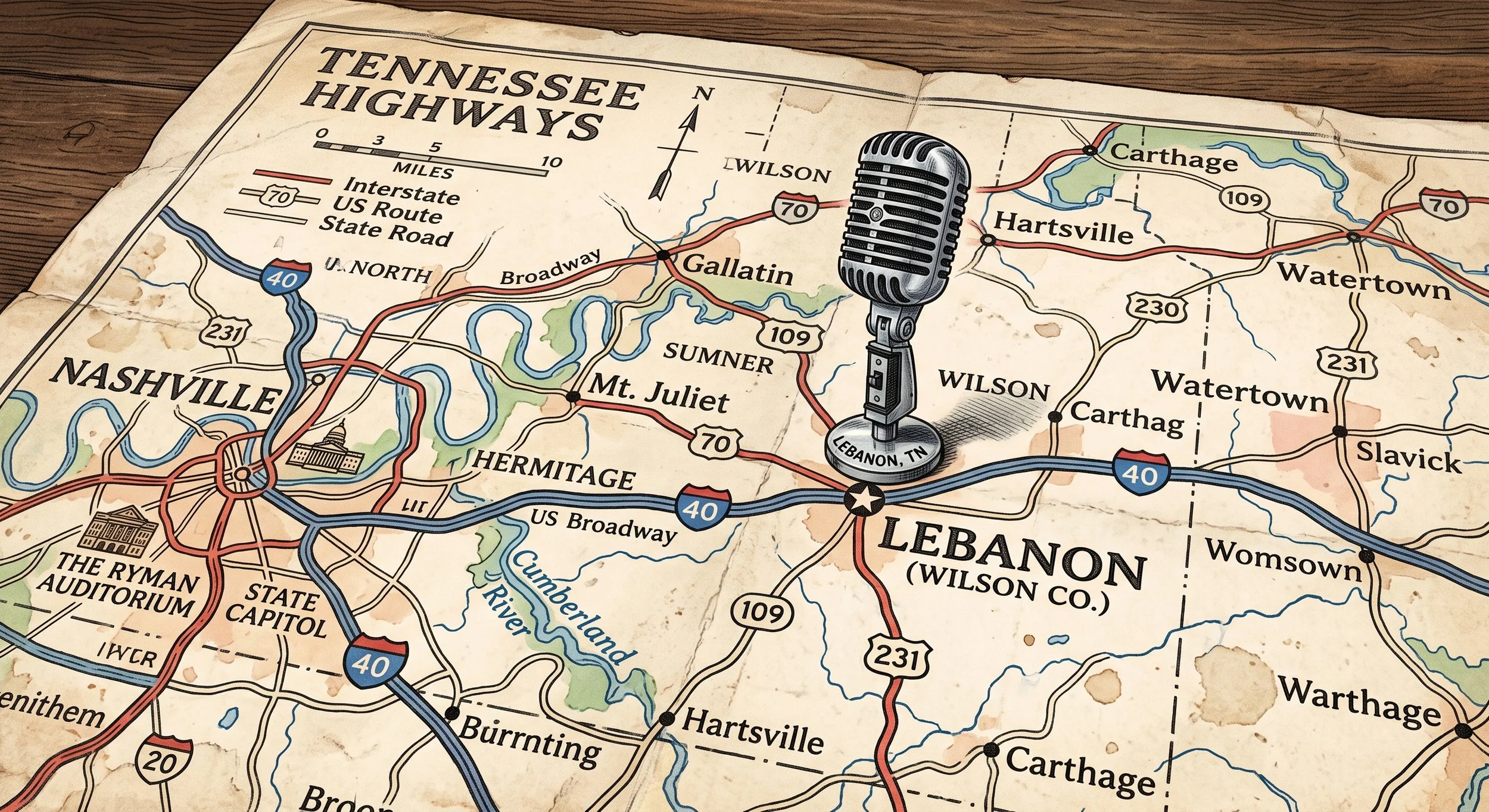
Scanning a map, I found that Lebanon, Tennessee, actually exists—there it was, half an inch east of Nashville. And while I knew less than zero about the place, I knew that if being in Lebanon could make me feel half of what the song did, I had to see it for myself.
And so one spring morning I set off from New York with a carful of music and a whim. I crossed the Hudson into Springsteen’s “swamps of Jersey,” then counted the cars on the New Jersey Turnpike until I reached “The Sound of Philadelphia” by MFSB. By noon I made Nina Simone’s “Baltimore,” then cut west through Phil Ochs’s “Hills of West Virginia.” From there I hauled it “Across the Blue Ridge Mountains” with Flatt & Scruggs. Bill Monroe took me from “Roanoke” to “East Tennessee Blues,” where I caught John Fahey’s “Knoxville Blues.” Thirty miles east of Nashville, I cued up the Sexsmith track, and with the lyrics as my guide, took the exit marked “Lebanon.”
Get off the bus on the border of town
Head in from the east
Walk into a bar, take a seat in the corner
Be a man of mystery
Here the border of town was a two-mile strip of motels, truck stops, and discount appliance stores, the marquee outside one reading:
JOHN 20:31
WASHER DRYER 279.99
There weren’t many bars to walk into on a Sunday. A biker joint called the Players Club looked like the kind of place where a man of mystery might get the bejesus kicked out of him. Instead I tried my luck at the Waffle House, taking a seat in the corner as prescribed. The late crowd consisted of three bleary-eyed truckers on cross-country runs. They’d never heard the Sexsmith song.
“Ah, but I bet you know the way to San Jose!” I said. No one laughed.
Folks don’t treat you mean in Lebanon, Tennessee
But like a human being—they’ll take you in off the street
They’ll bring you in their homes down there
And give you something to eat
While no one took me in off the street, I found adequate lodgings at the local La Quinta, and the next morning I was given something to eat (eggs, grits, biscuits, and gravy) at the Cracker Barrel off I-40. Lebanon, it turns out, is the birthplace of the Cracker Barrel chain, whose faux-folksy cornpone restaurants proliferate like kudzu along Southern interstates.
From a brochure near the gum-ball machine I learned that Lebanon, seat of Wilson County, has a population of 21,000 and was home to both Sam Houston and the original Aunt Jemima. Today the county’s best-known residents were Charlie Daniels and Reba McEntire. I also learned that Lebanon’s own Cumberland University holds a college football record for being beat by Georgia Tech, in 1916, by a score of 220 to nothing.
I spent the morning strolling around the town square, with its Civil War monument, barber poles, and dozens of antiques dealers. Lebanon, I discovered, is the self-proclaimed “Antique City of the South.” “Five-dollar charge to look through window—free if you come on in!” said a sign outside one store. I browsed through piles of estate jewelry and hunting knives at Cuz’s Antiques, then took a drive down West Main Street, a broad avenue lined with weathered Victorians that soon gave way to car dealerships and drive-ins, and, finally, to rural Tennessee. It was pretty, for about eight minutes. Then I got bored and turned back into town.
Outside Bonker’s Pizza I cornered a few skateboarding teenagers and played the Sexsmith song for them. They weren’t convinced that Lebanon was “as good a place as any,” but they admitted the tune was catchy.
Weirdly enough, no one I met in Lebanon knew of the song’s existence. Ron Sexsmith is hardly a household name, but you’d figure a tribute to a town of 21,000 people might get some local airplay.
After lunch I paid a visit to the Lebanon Chamber of Commerce, where Executive Director Sue Vanatta was “tickled pink” to learn there was a song honoring her hometown. We sat in her office and listened together, with Sue cheerily fact-checking the lyrics in real time.
There’ll be a job in Lebanon, Tennessee
“That’s probably true,” Sue whispered. “Wilson County has just three percent unemployment!”
I’ll work on a farm, I’ll work in some factory
“Well, probably not farm work these days. There is the Hartmann Luggage factory—world headquarters, right here in Lebanon. Very nice luggage!”
Despite her Tennessee accent, Sue reminded me of people in the small New Hampshire town where I grew up—sturdy, no-nonsense, proud natives through and through. And I realized what had been nagging at me since my arrival in Lebanon: switch the grits for home fries and the Confederate soldier for a Minuteman, and Lebanon could be my hometown. A place where school lunch menus get 12 column inches in the newspaper; where the downtown movie palace has been abandoned for a multiplex; where folks stick around for life, and their children do, too; and where no outsider in his right mind would spend a vacation.
Which isn’t to deny that Lebanon is a charming little place. But in the end, it was no match for the song. I thanked Sue and bid her good-bye, took one last spin around the square, then hit the highway, bound for Nashville.
Back in New York, I managed to reach Ron Sexsmith by phone from his home in Toronto. I told him I’d driven 15 hours to Lebanon all because of his song.
“Seriously?” he said, sounding amused and bewildered. “You know, when I wrote that song I’d never even been there. Still haven’t!”
“Oh?” I said, trying to hide my disappointment.
“Yeah, years ago I was working as a courier here in Toronto. One day a box came into the mailroom postmarked ‘Lebanon, Tennessee.’ The sound of those two words just hit me. I walked out of the mailroom singing to myself: ‘I’m going down . . .’ Like a mock country song. It actually started as kind of a joke.”
“Mmm-hm.”
“But the more I got into it, the more it seemed to take on a deeper story line. I guess people can relate to that idea of wanting to start over somewhere. It was nice not knowing anything about the town—in fact, I kind of stayed away on purpose.”
“Right,” I said. “Probably a good idea!”
So it was a silly endeavor, driving all the way to Lebanon. But I had no regrets. How many poets have traveled to the mountain in Yeats’s “Under Ben Bulben” only to find a molehill? Had they known, most would still have made the trip. It’s the going that matters, not the arrival. Reality, after all, is only a part of it; the traveler fills in the rest. One takes from a place what one brings. Some of us bring Yeats. Some bring Michelin. And some of us bring Ron Sexsmith. •